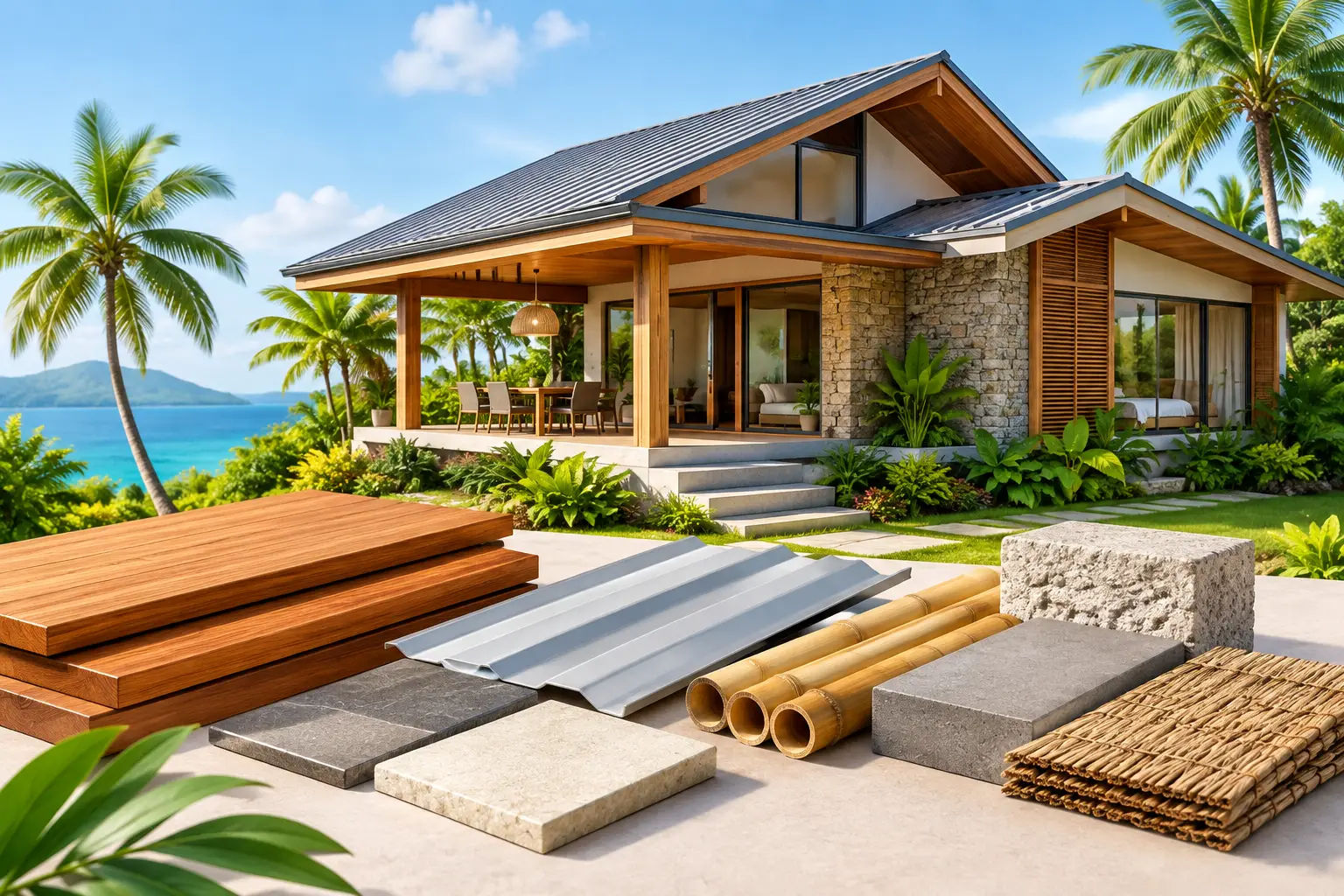
A tropical home is tested long before its owner moves in. In Yaoundé, Douala, and many parts of Cameroon, heavy rainfall, high humidity, intense sun, lateritic soils, and termites can quickly expose a weak material choice or poor site detail. The best materials for tropical homes are not simply the most expensive ones. They are materials selected as a system - with the right structural design, drainage, roof detailing, workmanship, and maintenance plan.
For a villa, duplex, apartment building, school, or commercial property, material decisions should begin during architectural and engineering design. Changing specifications after construction starts often leads to uncontrolled costs, uneven quality, and details that do not work together.
What Tropical Conditions Demand From a Building
A successful tropical building must manage water in several forms: driving rain from the roof, groundwater around foundations, moisture moving through walls, and humid air inside rooms. It must also resist solar heat, biological growth, insects, corrosion, and day-to-day wear.
This is why a material that performs well in a dry climate may disappoint in a wet tropical environment. Untreated timber may attract termites. Thin roofing sheets can make upper rooms uncomfortably hot. Poorly made hollow blocks can absorb water and crack. Ordinary steel can corrode early when moisture reaches it through inadequate concrete cover or leaking roof details.
The solution is not to eliminate every risk with premium materials. It is to specify appropriate materials where they matter most and protect them with sound design. A well-built home uses roof overhangs, raised floor levels, proper slopes, gutters, drains, damp protection, ventilation, and correctly executed joints to help its materials last.
Best Materials for Tropical Homes: Start With the Structure
Reinforced concrete for foundations and frames
Reinforced concrete remains one of the strongest choices for foundations, columns, beams, suspended slabs, retaining walls, and staircases in Cameroon. Properly designed reinforced concrete offers strength, fire resistance, good availability, and flexibility for modern architectural forms.
Its performance, however, depends on engineering discipline. Foundation type must respond to the soil investigation, building loads, groundwater conditions, and site slope. Concrete must be mixed to the specified strength, compacted correctly, cured adequately, and reinforced with correctly placed steel. Insufficient concrete cover, poor curing, or unwashed aggregate can reduce service life even when a building appears solid on handover.
For coastal or persistently wet areas, corrosion protection deserves additional attention. The design may require stronger concrete, increased cover to reinforcement, careful crack control, and reliable waterproofing at exposed slabs and retaining walls. Concrete is durable, but it is not maintenance-free when water is allowed to penetrate repeatedly.
Quality masonry blocks for infill walls
Concrete masonry blocks are widely used because they are practical, familiar to local contractors, and suited to residential construction. For external walls, the key issue is quality rather than simply block size. Well-produced blocks with consistent dimensions and sufficient strength support better wall alignment, reduce excessive mortar joints, and provide a more dependable base for plaster and finishes.
In areas with heavy rain, external masonry needs a complete moisture-control strategy. This includes a damp-proof course above ground level, sound external plastering, properly formed window sills, drip edges, and paint or render systems designed for exterior exposure. Walls should not sit where surface water collects.
Laterite blocks and compressed earth blocks can be valuable for specific projects, especially when local sourcing and thermal comfort are priorities. They require careful technical selection, protection from direct rain, controlled production, and details such as raised plinths and generous roof overhangs. They are not a shortcut material for every site, but they can deliver a distinctive and comfortable result when designed properly.
Steel used selectively and protected well
Structural steel is useful for long spans, light canopies, roof trusses, staircases, gates, balcony rails, and commercial structures. It can reduce the weight of a roof structure and allow more open interior spaces than conventional timber framing.
The trade-off is corrosion. Steel exposed to tropical rain and humidity must be properly detailed to prevent water from pooling and must receive an appropriate protective coating system. Galvanized steel is often a sensible choice for roof framing and external components, while painted mild steel needs thorough surface preparation and periodic repainting. Hidden steel connections also need inspection access where possible.
Do not choose steel only for its clean modern appearance. Specify its section sizes, connections, coatings, and maintenance requirements before fabrication begins.
Roofing Materials That Control Heat and Rain
The roof is one of the most important climate-control components in a tropical home. A roof that leaks, overheats, or is poorly anchored can undermine an otherwise well-built project.
Long-span aluminum-zinc coated roofing sheets are commonly selected for their availability, light weight, and resistance to corrosion. They can work very well when installed with correct laps, flashings, screws, ridge details, and gutters. A thicker sheet usually performs better against denting, noise, and premature deterioration than an economy-grade alternative.
For greater thermal comfort, pair the roofing with insulation, a reflective underlay, ceiling void ventilation, and a well-designed ceiling. The roof color also matters. Lighter colors generally absorb less heat than dark finishes. In bedrooms and upper-floor spaces, this combination can make a meaningful difference to indoor comfort and air-conditioning demand.
Clay or concrete roof tiles can provide excellent appearance and thermal mass, particularly for high-end villas. Their higher weight requires a roof structure designed for the load, and installation quality is essential. Tiles are not automatically better than metal sheets. On a constrained budget, a high-quality metal roof with insulation and strong detailing may deliver better overall value.
Roof overhangs should be treated as part of the material strategy. Wide eaves shield walls, windows, and doors from rain and direct sun, reducing paint failure and water entry over time.
Windows, Doors, and Glazing for Humidity and Security
Aluminum windows and doors are a dependable option in humid tropical locations because they do not rot and require relatively limited maintenance. Powder-coated aluminum frames can retain their finish well, provided the profile quality, drainage channels, hardware, and installation are properly controlled.
For homes near busy roads or in high-rainfall zones, window selection should consider more than aesthetics. Good seals, correctly flashed openings, insect screens, durable handles, and secure locking systems all contribute to year-round performance. Large glass walls may look impressive in a rendering, but excessive west-facing glazing can create uncomfortable heat gain. External shading, deep reveals, louvers, or screened verandas often provide a more climate-responsive solution.
Timber doors can bring warmth and character, but they should be made from properly seasoned, termite-resistant species and protected from direct weather exposure. Engineered or metal security doors may be the more practical choice for external entries, while quality timber is reserved for interior doors and protected feature elements.
Finishes That Resist Moisture, Mold, and Wear
Exterior finishes need to shed water while allowing the wall assembly to manage moisture appropriately. A correctly applied cement-sand render, cured before painting, is a proven solution for many masonry homes. Use a reputable exterior-grade coating with resistance to moisture, mildew, and ultraviolet exposure. The surface preparation matters as much as the paint brand.
Inside bathrooms, kitchens, balconies, and laundry spaces, porcelain or quality ceramic tiles are reliable choices because they resist water and are easy to clean. On floors, select slip-resistant finishes for wet areas and external walkways. Polished tiles may look refined in a showroom but can become hazardous around a pool, entrance, or uncovered terrace during rain.
Natural stone can be attractive for entrance walls, terraces, or landscaping features, but porous stone needs sealing and drainage behind cladding. For countertops and heavy-use surfaces, granite and engineered stone can offer better durability than softer finishes, depending on the client’s budget and maintenance expectations.
Timber, bamboo, and decorative materials
Natural materials can make a tropical home feel grounded and elegant, but they must be used in the right locations. Treated timber works well for ceilings, pergolas, screens, furniture, and protected cladding. It should not be relied upon for ground-contact elements or exposed roof members without a clear treatment and maintenance strategy.
Bamboo can create striking screens and landscape structures, yet it needs treatment, protection from water, and careful joinery. Decorative materials should support the building’s durability rather than introduce a future repair burden.
Do Not Ignore Drainage and Waterproofing Materials
The best wall blocks and roof sheets cannot compensate for water sitting against a building. Drainage is a construction material decision as much as an excavation task. Gutters, downpipes, channel drains, inspection chambers, gravel layers, geotextiles, waterproof membranes, and properly sloped paving all protect the structure.
Below-grade walls, basement spaces, retaining walls, and wet rooms require purpose-made waterproofing systems. A coat of paint is not a substitute for a specified membrane, protected application, and drainage route. On sloping sites common around Yaoundé, retaining structures and stormwater management should be coordinated early with the structural and architectural plans.
Choose a Material Package, Not Isolated Products
A durable tropical home results from coordinated decisions. Reinforced concrete needs the right foundation design. Masonry needs damp protection and exterior finishing. Roofing needs insulation, ventilation, and rainwater disposal. Steel needs corrosion protection. Windows need shading and correctly formed openings.
Before purchasing, ask for material specifications that identify required grades, thicknesses, finishes, approved alternatives, and installation standards. A bill of quantities should separate structural, roofing, finishing, plumbing, and drainage items clearly enough to compare contractor prices without silently reducing quality. Site supervision then confirms that the approved specification is what reaches the building.
Landmark Consults approaches these decisions through integrated architectural design, structural engineering, quantity surveying, and construction monitoring, helping clients protect both their vision and their investment from the first drawing to final inspection.
Before committing funds to finishes or imported products, invest in a complete design and site-responsive specification. The material that serves your home best is the one that has been engineered, detailed, installed, and protected for the climate it will face every day.